Belinda of the Dorans
Finnegans WakeBelinda of the Dorans is the elderly hen who uncovers a stained letter in a rubbish heap and becomes the unlikely guide to its damaged, unstable text. Her discovery joins animal behavior to the book’s recurring problems of evidence and interpretation: the letter has been partly erased by its burial, its remaining features are distorted, and readers are urged to follow the hen’s example rather than assume that its meaning is immediately plain.
Discovery in the rubbish heap
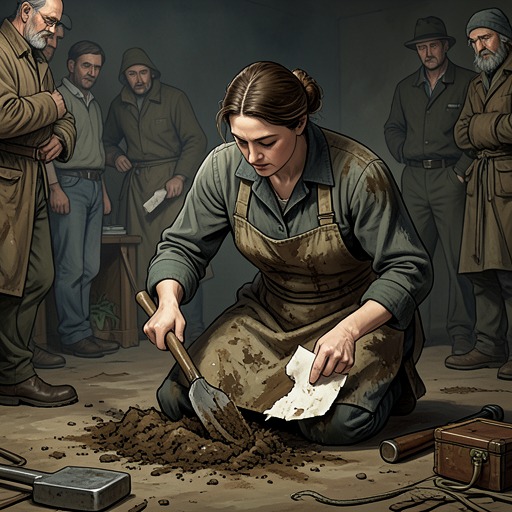
The discovery is staged in winter, with spring only a promise. A small, cold child encounters a fowl behaving strangely on a midden or rubbish dump, a place later transformed into an orangery. Excavation there brings up fragments of orange peel, suggesting that someone had eaten outdoors at some unknown point in the past. The child’s find is likened to the discovery of the Ardagh chalice by another innocent beachcomber, so an apparently lowly act of searching acquires the shape of an archaeological revelation.
The bird is identified as Belinda of the Dorans, described as more than fifty years old. At noon she scratches at what looks like a large sheet of letter paper, transported from Boston. Its conventional epistolary scraps include domestic greetings, reports of health, family news, wedding cakes, a funeral, kisses, and a closing signature. A tea stain marks the paper as an apparent relic of an older Irish literary culture. The letter is at once a household communication and a recovered artifact, its ordinary social language rendered strange by age and damage.
The letter as damaged evidence
The narrator explains the letter’s condition through the image of a photographic negative of a horse melting during development. The resulting picture would be grotesquely distorted: features nearer the viewer swell, while those farther away become difficult to make out. The letter, too, has spent time in the heart of an orange-colored mud mound. Heat has partly obliterated it and magnified some features at the expense of others, leaving the reader to imagine the lost or obscured portions.
This account makes the physical history of the page part of the problem of reading it. The document does not arrive as a clean, authoritative record; it comes through soil, stain, partial destruction, and a chain of acts that includes the hen’s discovery. Its legibility is uneven, and the narrator’s photographic comparison offers not a definitive reconstruction but a model of how distortion changes what can be seen. Belinda is thus associated with the letter’s recovery without being made to resolve its uncertainties.
A guide to reading
The passage directly invites the reader to follow the hen. Belinda’s ordinary capacities—flying, moulting, hatching, and agreeing in the nest—are invoked as forms of knowledge grounded in recurring life rather than abstract authority. She is said to sense her role in laying and loving eggs and in protecting her young through danger. The account imagines her as acting with natural competence, while human readers struggle to extract sense from a confusing sack of old writing.
That appeal gives the hen interpretive force. Belinda’s guidance does not amount to a translation of the letter or a claim that every trace can be recovered. Instead, the passage sets her confidence in animal continuity against the reader’s uncertainty among the text’s tangled fragments. Its injunction to follow the fowl makes the act of reading resemble attentive foraging: meaning may be gathered, but only through patience with what survives.
Significance
Belinda’s discovery recasts a commonplace bird and a discarded document as partners in the production of literary evidence. The page’s domestic contents suggest correspondence among family and acquaintances, while its battered form makes any simple account of its message unreliable. The hen’s place at the scene connects reading to material traces and to the repeated cycles of laying, hatching, and renewal that the passage associates with a return of the golden age.
The episode’s force lies in its reversal of customary authority. A reader faced with a damaged letter is told to take direction from an old hen, not because she supplies a complete account, but because her life embodies a recurring knowledge of continuation and care. Belinda therefore stands at the meeting point of textual disorder and natural recurrence: the document is distorted and difficult to read, but its recovery opens another chance to search, interpret, and begin again.